AFlat roof problems build for months before a ceiling tile starts dripping. The sequence is consistent: a membrane compromise, a drainage gap, a flashing separation that goes unaddressed while water moves below the surface. By the time interior evidence appears, the scope of damage above has already grown. Understanding what each warning sign means for your roof’s remaining service life is what separates a managed repair from a capital emergency. A commercial roofing inspection checklist gives you the evaluation framework; this post explains what each signal requires from you.
At a Glance:
- Flat roof problems develop over weeks or months before interior evidence appears. When ceiling staining shows up, the moisture above it has often been accumulating since the previous season.
- Ponding water that remains beyond 48 hours after rainfall indicates drainage failure and accelerates membrane deterioration at a rate that compounds over time.
- The line between repair and replacement depends on roof age, scope of affected area, and whether moisture has reached the deck. A professional inspection is required to answer that accurately.
Flat Roof Problems Develop in Stages
Flat roof failures rarely happen at the moment of origin. A flashing separation at a parapet wall allows only a small amount of water entry initially, but that water soaks into the insulation below, retaining moisture and degrading the substrate. By the time saturated insulation is discovered, the flashing above it may have been compromised for more than a year. A consistent commercial roof maintenance plan builds the documented baseline that makes those changes visible before the damage compounds.
Signs That Indicate Active Roof Deterioration
Not every surface anomaly on a commercial roof is a crisis. Some conditions are cosmetic; others indicate active moisture infiltration that compounds if left unaddressed. The warning signs below fall into the second category.
Ponding Water Beyond 48 Hours
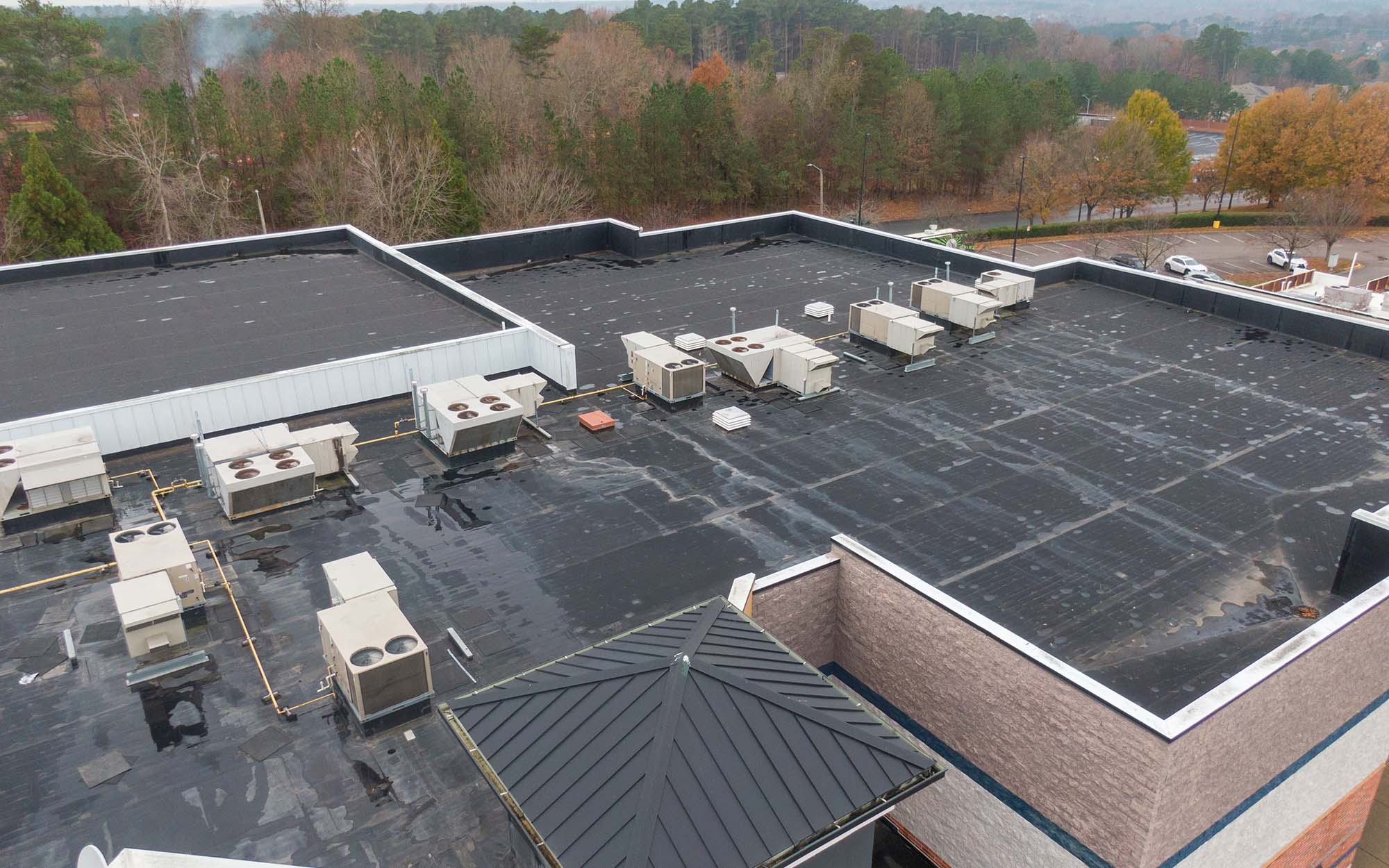
Flat roofing systems are designed to drain within 48 hours of rainfall. Water that remains beyond that window indicates drainage system failure. Standing water adds structural load to the deck, accelerates membrane breakdown, and creates conditions for algae growth and fastener corrosion. On built-up and modified bitumen systems, long-term ponding softens the bitumen layers below; on single-ply systems, it increases seam stress and UV degradation. Any section that consistently holds water after rainfall should be flagged for your next flat roof inspection, not deferred.
Membrane Blistering and Surface Deformation
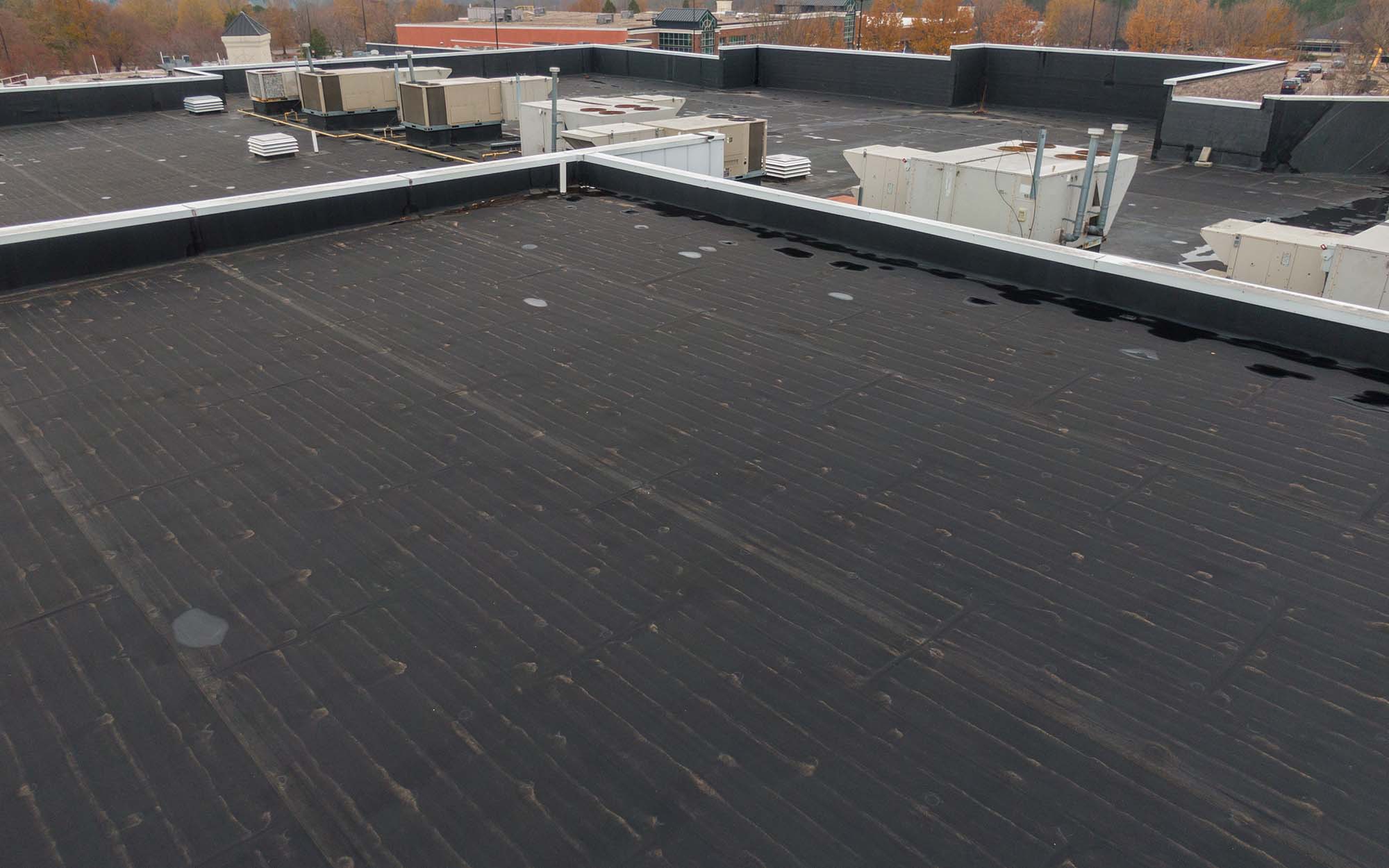
Blisters are raised areas where air or moisture has become trapped between membrane layers, either from installation conditions or loss of adhesion in an aging system. Large blisters, blisters near seams, or any that have ruptured create direct water entry points requiring professional evaluation. Related surface deformations, including membrane shrinkage or separation from flashings, pull terminations loose and open seams at roof edges, two of the highest-risk locations for water entry on any low-slope system.
Flashing Failures at Parapets, Penetrations, and Equipment Curbs
Flashing seals the transitions between the membrane and vertical surfaces: parapet walls, pipe boots, HVAC curbs, and drains. Failing flashing allows water to bypass the membrane entirely and enter the building at the point of penetration. The National Roofing Contractors Association (nrca.net) identifies flashing integrity as a primary indicator in any roof condition evaluation, noting that deterioration at termination points typically advances faster than membrane deterioration across the field of the roof. Signs include visible gaps at parapets, rust below metal termination strips, and cracked or separated sealant.
Interior Moisture Evidence and Rising Energy Costs
Ceiling stains, mold near exterior walls, and sagging drywall indicate water is already inside the building envelope. By the time moisture is visible at ceiling level, it has typically moved through the insulation layer above, accelerating deterioration considerably. Energy cost increases without an obvious explanation are a closely related signal: saturated insulation loses thermal resistance, forcing extended HVAC cycles. The U.S. Department of Energy (energy.gov/buildings) identifies wet roof insulation as a significant contributor to commercial building energy loss. Unexplained utility cost increases warrant an infrared roof scan before assuming another cause.
Visible Seam Separation and Edge Lifting
Seams are the stress points of any membrane system. On mechanically fastened single-ply roofs, thermal expansion cycles fatigue the adhesion at lap joints over time; on fully adhered systems, seams lift when the adhesive degrades or moisture migrates below. Edge conditions at drip edges and perimeter flashings are equally vulnerable: lifted edges allow wind to work underneath the membrane, producing rapid damage across large surface areas. Any visible lifting at seams or edges requires attention before the next weather event.
If your roof shows any of the warning signs described above, a professional inspection is the logical next step. The Superior Group uses drone imaging and infrared thermography to identify surface damage and subsurface moisture that visual checks miss.
When Flat Roof Problems Cross From Repair to Replacement
Combinations of warning signs on an aging roof shift the conversation from repair to replacement. Three variables determine the appropriate path: how old the system is relative to its expected service life, what percentage of the surface is affected, and whether moisture has reached the deck.
| Condition | Typical Path | Key Consideration |
| Isolated membrane puncture, dry insulation below | Repair | Act before next weather event |
| Flashing separation, limited area, system under midpoint of service life | Repair or restoration | Assess subsurface moisture extent before committing |
| Multiple simultaneous leaks, aging system at or past midpoint | Assessment required | Repair ROI likely unfavorable |
| Widespread membrane failure or moisture confirmed at deck level | Replacement | Delay compounds deck repair cost |
The reroof versus replacement decision requires physical assessment of deck condition, insulation saturation, and remaining membrane adhesion. Accurately forecasting commercial roof replacement costs over a 10-year horizon requires that same data, which is why owners who plan a replacement two to three years in advance consistently have more budget flexibility than those responding to an emergency.
How The Superior Group Evaluates a Failing Commercial Roof
The Superior Group provides free roof evaluations for building owners, facility managers, and property operations leaders across Connecticut, Massachusetts, New Hampshire, Vermont, Rhode Island, New Jersey, Pennsylvania, Virginia, Maryland, and West Florida. Each evaluation uses drone imaging and infrared thermography to document surface-level conditions and subsurface moisture that visual inspection alone cannot detect, producing a condition report with a professional recommendation for the appropriate path forward.
Facility managers who maintain a structured commercial roof inspection schedule and observe a change in conditions since their last visit should not wait for the next scheduled appointment. A change between inspections indicates accelerating deterioration.
Frequently Asked Questions About Warning Signs of Commercial Roof Failure
How quickly can flat roof problems develop into structural damage?
The timeline depends on the type of failure and the conditions it encounters. A membrane puncture over dry insulation may remain contained for months; a flashing separation during a wet season, over moisture-retaining insulation, can produce significant interior damage within a single event.
Are ceiling stains always caused by roof failure?
Not always. HVAC condensation, plumbing leaks, and window seal failures produce similar staining. However, staining on the underside of a flat roof that does not correlate with any overhead mechanical system should be attributed to roof infiltration until a professional inspection confirms otherwise.
What does ponding water do to a flat roof membrane over time?
Water beyond the 48-hour threshold adds structural load to the deck, promotes biological growth that degrades surface materials, weakens adhesive bonds, and concentrates atmospheric contaminants that attack the membrane. Both modified bitumen and single-ply systems lose service life at an accelerated rate under persistent ponding.
How do I know whether flat roof problems are repair- or replacement-level issues?
The answer depends on roof age relative to rated service life, the percentage of total area affected, and whether moisture has reached the structural deck. Thermographic imaging and physical core sampling provide the data required for a defensible recommendation. Visual inspection alone cannot answer this question accurately.
How often should a commercial flat roof be inspected?
Twice per year is the industry standard: spring inspections assess winter damage from freeze-thaw cycling and ice load; fall inspections confirm drainage is clear and address summer UV wear. Additional inspections should follow any significant weather event or any report of interior moisture evidence.
Your Roof Signals Trouble Before It Fails
The warning signs above follow a predictable sequence, and each is a decision point: address it while the scope is defined, or wait until a later inspection confirms it has grown. The Superior Group provides free roof inspections for property owners and facility managers across the Northeast, mid-Atlantic, and West Florida.